

Log in to Wordpress here
Hits to date
- 33,967 potential critics
David Hodges

-
I like to be called David, but “Mister Hodges” and “Professor” are popular choices. My ESL students’ charming alternative, “Mister David,” is my favorite by far.
Agenda MON OCT 06
Posted in davidbdale, Professor Post
Leave a comment
HW Brevity and Clarity
I could assign the same homework every day and never be wrong to require your constant effort to achieve brevity and clarity. Strunk and White, the authors of The Elements of Style, famously offered the essential writers’ advice in language that proves its own effectiveness:
Omit needless words.
I need more from you than that, but it’s a very good start.
After reading my other post, “Brevity and Clarity. The Short Sentence,” and following the example offered there, collect a paragraph of any of your classmates’ A03 assignment and edit it as I have demonstrated, to eliminate repetition and wordiness, and to reduce the paragraph to its essentials.
ASSIGNMENT DETAILS
- Publish under the title: Brevity MW—Username (substituting your username of course).
- Copy and paste another student’s paragraph from an A03 assignment into your post.
- Revise the paragraph for brevity and clarity.
- Use blockquotes if possible.
- Categorize your post as Brevity MW and in your username.
- DEADLINE: 11:59PM TUE OCT 07.
Posted in davidbdale, Professor Post
Leave a comment
Brevity and Clarity. The Short Sentence.
I will occasionally call your attention to articles I find in the paper we use as a textbook, for their news value, for their educational benefit, or out of a compulsion to share.
This one, from the a September 2013 edition, offers advice so helpful for students who want to avoid sounding pedantic that I’ve saved it for a year. Your writing courses may mistakenly have encouraged you to load up your essays with elaborate sentences crammed with tortured or even invented multisyllabicisms. Roy Peter Clark and I would like to warn you against making that mistake. Your language can and should be bold and clear.
I love short sentences, bold claims. Even fragments used effectively.
Like any other rhetorical device, they can be overused, but the reverse is worse. Endless paragraphs of wordy sentences that mindlessly repeat the same vague claims for no other reason than to satisfy a word count should and will be actively discouraged. I blame the word counts.
Express your 25-word idea in 25 words, not 250. Then have another 25-word idea and give it its due. String together enough 25-word ideas and you’ll have an essay that’s full of ideas, whatever its length. A grades go to writers who pack the most good ideas into their short essays.
Here’s an example of a student trying to pad too few ideas:
As a summer resident of Ocean City, NJ, I saw damage done by this storm locally and the damage was unbelievable. Luckily, I own a small condo elevated on the second floor of a converted motel raised approximately 8 feet above the ground. Although my home was not personally flooded or damaged, the amenities that our building provides were. All of the offices and game rooms on the first floor of our building suffered approximately 3 feet of water damage due to the rise of the back bay flooding our building and pools leaving the damages to rehabilitate our complex in the thousands. While fortunate enough to own a boat, I was lucky enough to not see any damage to it. Some friends and acquaintances of mine lost their boats due to sinking, docks completely ripped to shreds, and buildings demolished from winds and rising water levels. Although I have personal ties I recognize that the idea to rebuild is crazy.
The edited version
Ocean City, NJ was devastated by the storm. Our 2nd-floor summer condo was not flooded, but the offices and game rooms took on 3 feet of back bay water. Repairs will be expensive. Our boat was also undamaged, but our friends’ boats were sunk, their docks shredded, their buildings demolished by winds and flood. My affection for the town is genuine, but it would be crazy to rebuild.
Posted in davidbdale, Professor Post
Leave a comment
Agenda THU OCT 02
- A Good Sentence
- Blog Mechanics
- Editorial Assignment
- Editorial Study
Posted in davidbdale, Professor Post
Leave a comment
Ed exercise – mica
For much of the past six years, President Obama has talked about working toward a world without nuclear weapons. Yet his administration is now investing tens of billions of dollars in modernizing and rebuilding America’s nuclear arsenal and facilities, as The Times reported in detail on Monday. And after good progress in making nuclear bomb material more secure around the world, Mr. Obama has reduced his budget requests for that priority. This is a shortsighted and disappointing turn.
With the fight against the Islamic State in Iraq and Syria dominating news headlines, it is easy to forget the threat that nuclear weapons and nuclear material continue to pose around the world. The Bulletin of the Atomic Scientists says there are 16,300 nuclear weapons located at some 98 sites in 14 countries, a vast majority in the United States and Russia. There are also 25 countries that possess enough nuclear and radiological materials to build a weapon, with such material held at hundreds of sites, many vulnerable to extremists.
When he first came to office, Mr. Obama was clearsighted about nuclear dangers and ambitious in his disarmament goals. His major arms control achievement was the New Start treaty with Moscow aimed at reducing deployed strategic nuclear weapons to 1,550 on each side, down from 2,200, by February 2018. But to win Republican support for the treaty in 2010, Mr. Obama made a Faustian bargain, promising to spend $84 billion to upgrade aging nuclear weapons over the next decade, a $14 billion increase over the regular $70 billion modernization budget.
But the Congressional Budget Office now estimates that Mr. Obama’s plans will cost $355 billion over the next decade; other studies put the price at $1 trillion over three decades. The wish list includes 12 new missile submarines, up to 100 new bombers, 400 land-based missiles, plus upgrades to eight major plants and laboratories.
There has been little debate among members of Congress and the public about the decision by Mr. Obama and Congress to pour billions of dollars into new nuclear weapons systems — even as other government programs have been cut significantly.
Not only is this spending unwise and beyond what the nation can afford, multiple studies by the Government Accountability Office have described the modernization push as badly managed. In a statement released on Monday, nuclear weapons experts from the Arms Control Association, the Federation of American Scientists and others called the modernization plan excessive and said the country can reduce the number of missiles and bombers it buys and still maintain a safe and reliable nuclear arsenal.
Worse yet, the administration is making a foolish trade-off — pouring money into modernization while reducing funds that help improve security at nuclear sites in Russia and other countries where terrorists or criminals could get their hands on nuclear materials.
Since Mr. Obama took office, he has pushed the international community to improve nuclear security. The result is that 13 countries have eliminated their nuclear materials stockpiles and 15 others removed or disposed of portions of theirs. But a report by experts at the Belfer Center for Science and International Affairs at the Harvard Kennedy School of Government says the Obama administration’s proposed 2015 budget would cut spending for nuclear security by 21 percent, from $700 million this year to $555 million. While Congress restored some of that money in a stopgap spending bill, it expires in December and no one knows what happens after that.
Fortunately, 26 senators have recognized that such cuts are dangerous and urged that they be reversed. Investing in nuclear security protects Americans more than unwise investment in new nuclear weapons.
(The broken promises that I found you missed I highlighted in orange.)
This editorial post is repetitive, but that just makes the argument more definite and clear, also makes for an extremely well written post. The author never has to say “I think,” “I believe” or “in my opinion” because through the facts he/she gives their opinion is clearly stated. Through their argument they also give great support, by bringing up the studies done by the Government Accountability Office in the 6th paragraph. In addition the author brings up the statement made by the Arms Control Association, the Federation of American Scientists. This entire post clearly points out Obama’s broken promises and captures the audiences attention.
Posted in 123 Uncheck this box!
Leave a comment
Having Trouble Adding Color?
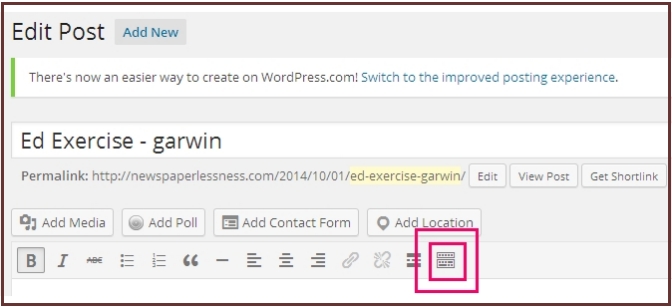
Your Edit tools include a color palette, but it’s not easy to find unless you know where to look. Here’s what the edit toolbar looks like when the toolbar toggle is not activated.
- The toggle toolbar is pretty clearly identified there by the two red squares. Activating the toggle reveals a second row of tools, including the color palette.
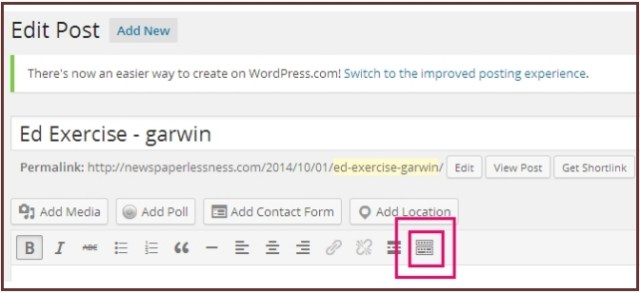
- Any text you select can be converted to whatever color you choose.

- Helpful?
Posted in davidbdale, Professor Post
Leave a comment
A Good First Sentence
Your colleague ipl37 wrote a dandy of a first sentence for the A02 assignment.
While high-tech car enthusiasts like me want to believe John R. Quain, whose September 12 article, “4G Wireless in the Car: Speeding with Impunity,” predicts new automobiles will be mobile hotspots, we’re afraid that high-speed surfing and highway safety are not compatible.
Look at all it accomplishes!
- It provides its author’s credentials (high-tech car enthusiasts like me).
- It provides a thorough citation (author, article title, date).
- It briefly summarizes the pertinent material from the original (predicts new automobiles will be mobile hotspots).
- It presents its author’s objection (high-speed surfing and highway safety are not compatible).
That objection is a bit vague. It doesn’t indicate exactly which the author prefers, surfing or safety, which it easily could. If it said surfing would reduce safety, we’d understand with less effort. But that’s a quibble. The sentence is a good model for an LTE opening.
Posted in davidbdale, Professor Post
Leave a comment
Agenda WED OCT 01
- A Good Sentence
- Core Values
- Not Because Exercise
- Editorial Study
- Editorial Assignment
Posted in davidbdale, Professor Post
Leave a comment
A03: Editorial
Editorial on a Specific Timely Topic
Continuing the serious business of the course, I’m assigning you another very specific type of persuasive writing, the Editorial.
Again, I am not trying to turn you into journalists. If I were, I would start by asking you to cover school board meetings and come back with boring factual reports. For this assignment, you won’t be doing any reporting or news gathering. Instead, you get to be the voice of the newspaper—which sounds very much like the voice of God—without any training whatsoever. We’re studying this writing style for its persuasiveness and its impersonality.
To begin, carefully read the news stories you have selected to be the primary sources for your own piece of persuasive writing. Notice your source material very likely makes references to speeches, acts of Congress, scientific studies, news reports, government documents, articles from other papers, or current news topics that have probably been covered in the New York Times. Click the links if they’re provided, or search for additional material you’ll want to read to be conversant with your topic before you write your editorial. There’s nothing more embarrassing than using the voice of God to say stuff that’s downright silly or uninformed.
ASSIGNMENT
1. Write an editorial for an unnamed newspaper with a very specific thesis on any current news story. You can use an article regarding the recent security breach of the White House as your primary source; or one about the efforts to contain ebola in Africa (or the recent first case of ebola to appear in the United States); or an article about the developing public protests of Chinese citizens in Beijing; or any recent story on a new story of substance that deserves coverage in an editorial.
2. Your editorial will adopt the tone and formality level of the editorials published every day in the Times. It will not use the first person singular under any circumstances. If it must use the first person plural, the “we” will be understood to mean “we humans” or “we Americans.” But the first person, even in the plural, is rare. Avoid referring to yourself at all if possible.
3. Your successful editorial will draw support from a number of sources, not only the provided materials. Use casual citation in your editorial, but hyperlink a word or phrase in your work to the source materials so we can read your work and your source side by side.
4. Your editorial will include these essential components
- It will identify either a meaningful problem or social condition that could have serious consequences if not addressed, or a chance to seize a rare opportunity to get things right
- It will offer evidence to persuade readers of its importance
- It will address alternatives to address the problem or ways to achieve the goal
- It will make at least one clear and specific recommendation or solution
5. Depending on your section, your post is due before class MON or TUE.
6. Title your essay: Editorial—Your Name
7. Post your essay to the A03: Editorial category.
8. Early Feedback
As always, if you post early and I have the time, I will provide early feedback you can use to improve your draft before receiving your first grade. I cannot promise I’ll have time, but when I do, I heartily enjoy helping any way I can.
GRADE SPECIFICS
- MW Section: DUE SUN OCT 05, 2014 before midnight.
- TR Section: DUE MON OCT 06, 2014 before midnight.
- This assignment will be graded on the basis of what it is, your best first draft of a continuing assignment. The grade it earns will remain in your grade report all semester, but in the 25% category.
- Customary late penalties. (0-24 hours 10%) (24-48 hours 20%) (48+ hours, 0 grade)
Posted in davidbdale, Professor Post
Leave a comment
Editorial Exercise TR
Backsliding on Nuclear Promises
By THE EDITORIAL BOARD, SEPT. 22, 2014
For much of the past six years, President Obama has talked about working toward a world without nuclear weapons. Yet his administration is now investing tens of billions of dollars in modernizing and rebuilding America’s nuclear arsenal and facilities, as The Times reported in detail on Monday. And after good progress in making nuclear bomb material more secure around the world, Mr. Obama has reduced his budget requests for that priority. This is a shortsighted and disappointing turn.
With the fight against the Islamic State in Iraq and Syria dominating news headlines, it is easy to forget the threat that nuclear weapons and nuclear material continue to pose around the world. The Bulletin of the Atomic Scientists says there are 16,300 nuclear weapons located at some 98 sites in 14 countries, a vast majority in the United States and Russia. There are also 25 countries that possess enough nuclear and radiological materials to build a weapon, with such material held at hundreds of sites, many vulnerable to extremists.
When he first came to office, Mr. Obama was clearsighted about nuclear dangers and ambitious in his disarmament goals. His major arms control achievement was the New Start treaty with Moscow aimed at reducing deployed strategic nuclear weapons to 1,550 on each side, down from 2,200, by February 2018. But to win Republican support for the treaty in 2010, Mr. Obama made a Faustian bargain, promising to spend $84 billion to upgrade aging nuclear weapons over the next decade, a $14 billion increase over the regular $70 billion modernization budget.
But the Congressional Budget Office now estimates that Mr. Obama’s plans will cost $355 billion over the next decade; other studies put the price at $1 trillion over three decades. The wish list includes 12 new missile submarines, up to 100 new bombers, 400 land-based missiles, plus upgrades to eight major plants and laboratories.
There has been little debate among members of Congress and the public about the decision by Mr. Obama and Congress to pour billions of dollars into new nuclear weapons systems — even as other government programs have been cut significantly.
Not only is this spending unwise and beyond what the nation can afford, multiple studies by the Government Accountability Office have described the modernization push as badly managed. In a statement released on Monday, nuclear weapons experts from the Arms Control Association, the Federation of American Scientists and others called the modernization plan excessive and said the country can reduce the number of missiles and bombers it buys and still maintain a safe and reliable nuclear arsenal.
Worse yet, the administration is making a foolish trade-off — pouring money into modernization while reducing funds that help improve security at nuclear sites in Russia and other countries where terrorists or criminals could get their hands on nuclear materials.
Since Mr. Obama took office, he has pushed the international community to improve nuclear security. The result is that 13 countries have eliminated their nuclear materials stockpiles and 15 others removed or disposed of portions of theirs. But a report by experts at the Belfer Center for Science and International Affairs at the Harvard Kennedy School of Government says the Obama administration’s proposed 2015 budget would cut spending for nuclear security by 21 percent, from $700 million this year to $555 million. While Congress restored some of that money in a stopgap spending bill, it expires in December and no one knows what happens after that.
Fortunately, 26 senators have recognized that such cuts are dangerous and urged that they be reversed. Investing in nuclear security protects Americans more than unwise investment in new nuclear weapons.
Homework Exercise (TR Section)
The first paragraph of the editorial has been color-coded blue to identify it in its entirety as a comparison between early promises made at the beginning of the Obama Administration and the situations that indicate those promises have been broken.
Much of the editorial that follows reiterates the claim that promises made by new President Obama have been broken, watered down, or not simply not fulfilled. I’ve color-coded that blue too.
1. Start a new post titled: Ed Exercise–Your Username.
2. Categorize it as Editorial Exercise TR under the Homework category (and of course put it in your username category
3. Uncheck Uncategorized).
4. Identify any text I might have missed that specifically repeats the theme of that broken promise to achieve a world free of nuclear weapons.
5. Explain why the repetition is rhetorically persuasive and well-written, OR why the constant drum-beating of the same tired claim is mere repetition.
Complete the exercise by 11:59 WED OCT 01
Posted in davidbdale, Professor Post
Leave a comment


 ahntkd99
 carahall
 andrewbecharaa
 athenapup4
 bane1900
 bestbaker123
 bmdpiano
 comp0327
 compclass8
 cynicalwordsmith22
 doglover441
 drippydoughnut
 drpaleontology
 gcatt310
 givemeclouttokens
 hershey515
 iamsleepy01
 imagination4421
 influenza123
 jackso23
 Jayv23
 kraemercali
 lazybear8
 lelebxby
 lg102015
 lovericeandnoodles
 lucbe219
 morra2024
 mpsj13
 roses0102
 Sub2MigzFilms
 smellycat23
 tenere84
 thefrontbottom
 voxpopuli75
 whosyourcookie22
 yankeefan25
 Newspaperlessness